Artificial intelligence is reshaping how call centres operate. From faster response times to highly personalized service and happier agents, AI for call centers is no longer a future concept, it is a practical tool that delivers measurable results today. Beyond traditional call handling, AI in IT service management is also streamlining internal processes, ensuring that support teams can respond more efficiently and effectively. By meeting customer expectations with AI-enabled support, businesses can improve performance, reduce costs, and elevate the overall customer experience.
Modern call centers are benefiting from a variety of AI applications that extend far beyond routine support tasks. Intelligent cloud platforms allow AI systems to scale effortlessly and manage massive amounts of customer data, providing real-time analytics, automated workflows, and predictive insights. Meanwhile, advanced computing technologies automate routine inquiries, detect patterns in customer behavior, and assist agents with context-aware suggestions, making every conversation more meaningful.
AI is also transforming customer engagement through intelligent marketing solutions. By analyzing call center interactions alongside other touchpoints, businesses can predict customer needs, deliver personalized recommendations, and support campaigns that resonate, all while keeping service seamless and satisfying. In addition, automated financial intelligence tools help monitor billing inquiries, detect transaction anomalies, and forecast customer spending patterns, allowing finance teams to proactively resolve issues and support agents with data-driven insights.
Together, these innovations demonstrate how AI can revolutionize call centers, creating smarter operations, more empowered agents, and happier customers.
Top 10 AI Solutions for Call Centers: Boosting Customer Experience and Agent Efficiency
When it comes to leveraging AI for call centers, choosing the right platform can make all the difference in performance, customer satisfaction, and operational efficiency. Here are the top 10 solutions that stand out in the market today:
1. Bright Pattern
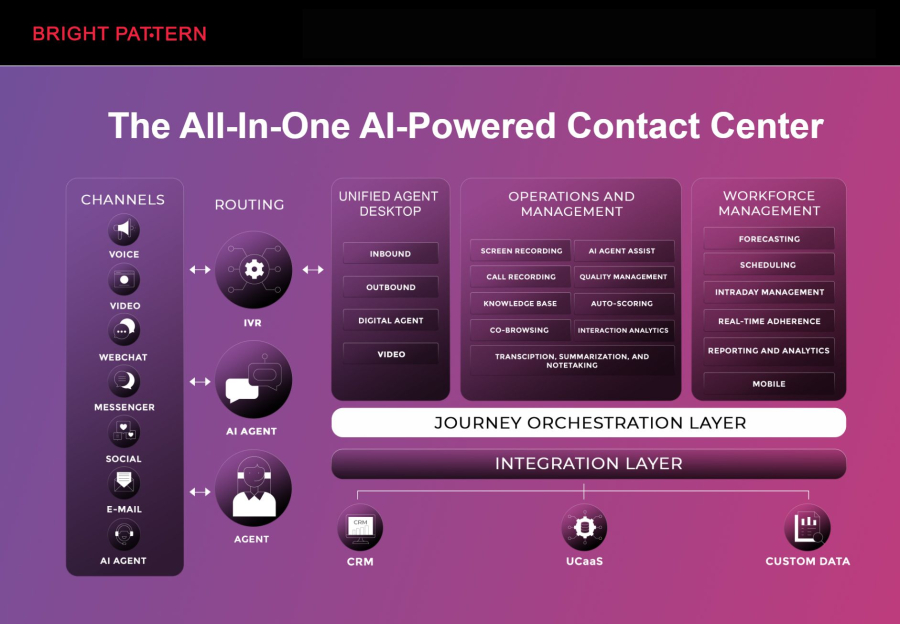
Bright Pattern leads the industry in AI-driven call center solutions, combining intuitive design, cloud-based flexibility, and advanced automation to help businesses deliver exceptional customer experiences. Its AI capabilities extend across predictive routing, automated responses, and sentiment analysis, ensuring that every interaction is personalized and efficient. Bright Pattern also integrates seamlessly with CRM systems, enabling agents to access customer context instantly.
With Bright Pattern, call centers can implement AI for call centers in a way that enhances agent productivity while reducing operational costs. The platform’s real-time reporting and analytics allow supervisors to track performance, identify trends, and make data-driven decisions. Additionally, its omnichannel capabilities mean customers can switch between voice, chat, email, and social media without losing continuity, providing a truly seamless support experience. Businesses also benefit from AI-driven quality assurance tools, helping maintain high standards of service and ensuring customer expectations are consistently met.
Key Features:
- Omnichannel support: voice, chat, SMS, email, and social media
- AI-powered routing and agent assistance
- Real-time analytics and reporting
- Integration with CRM and ITSM platforms
- Cloud-based architecture for scalability and reliability
- Tools for meeting customer expectations with AI-enabled support
- Automated quality monitoring and coaching
- Customizable workflows to fit unique business needs
2. Five9
Five9 offers cloud-based AI call center solutions focused on improving agent productivity and customer engagement. Its AI features include predictive dialers, virtual agents, and real-time coaching tools.
3. Genesys Cloud
Genesys Cloud combines AI, analytics, and workforce optimization to deliver personalized customer experiences across multiple channels.
4. NICE inContact
NICE inContact provides AI-powered call center software with tools for intelligent routing, self-service automation, and advanced reporting.
5. Talkdesk
Talkdesk integrates AI to enhance customer support, offering predictive analytics, automated workflows, and omnichannel capabilities.
6. Cisco Webex Contact Center
Cisco Webex Contact Center uses AI to provide smart routing, virtual agents, and analytics for improved customer satisfaction.
7. 8x8 Contact Center
8x8 leverages AI for predictive routing, quality monitoring, and real-time agent assistance, focusing on reducing wait times and improving resolution rates.
8. Zendesk Talk
Zendesk Talk integrates AI to enhance call routing, provide agent suggestions, and streamline customer support workflows.
9. Avaya OneCloud
Avaya OneCloud offers AI-driven analytics, virtual agents, and omnichannel engagement to optimize call center operations.
10. RingCentral Contact Center
RingCentral applies AI for call routing, workflow automation, and actionable insights, enabling better customer and agent experiences.
What Is AI for Call Centres?
AI for call centresrefers to software and tools that use machine learning, natural language processing, and automation to handle or assist customer interactions. These tools can understand speech or text, respond to questions, guide agents in real time, and turn large amounts of call data into useful insights.
AI does not replace your call centre. Instead, it augments your existing team by:
- Handling high-volume, repetitive questions automatically.
- Supporting live agents with suggested responses and next steps.
- Routing customers to the right person or channel more accurately.
- Analysing every interaction to reveal trends and opportunities.
Key Benefits of AI in Modern Call Centres
Well-implemented AI can generate value for customers, agents, and the business at the same time. Here are the main benefits call centre leaders in Canada can expect.
1. Better Customer Experience
- Faster responses:Virtual agents and intelligent IVR systems can answer common questions instantly, reducing hold times and abandon rates.
- 24/7 availability:AI does not sleep. Customers can get support outside regular business hours without needing to staff full overnight shifts.
- Personalised interactions:AI can pull in data from previous contacts, purchases, or account history to tailor recommendations and greetings.
- Consistent quality:AI is trained to follow policies and approved language, helping ensure that every customer receives accurate, compliant information.
2. Happier, More Productive Agents
- Less repetitive work:AI handles routine inquiries, so agents can focus on complex, high value conversations that require empathy and problem solving.
- Real time guidance:Agent assist tools listen to calls, surface relevant knowledge articles, and suggest the next best action, reducing cognitive load.
- Faster training and onboarding:New agents can ramp up quicker with AI driven coaching, recommended scripts, and automated quality feedback.
- Reduced burnout:When queues are shorter and tools are smarter, the workday feels more manageable, helping with retention and employee morale.
3. Stronger Operational Performance
- Cost efficiency:Automating common tasks lets the same team handle a higher volume of interactions without sacrificing quality.
- Smarter staffing:AI powered forecasting predicts volume by time of day, week, and season, helping workforce management teams schedule more accurately.
- Full visibility into every interaction:Speech and text analytics can review 100% of calls, providing insights that traditional sampling methods miss.
- Improved compliance and risk control:AI can automatically flag language that may indicate complaints, escalations, or regulatory risks, so supervisors can act quickly.
Key AI Technologies Powering Call Centres
Behind these benefits are several complementary technologies. Understanding them makes it easier to plan your AI roadmap and choose solutions that fit your needs.
Conversational AI and Virtual Agents
Conversational AIuses natural language understanding to interpret what a customer is saying or typing, and respond in a human like way. In a call centre context, this powers:
- Voice bots that greet customers, authenticate them, and resolve routine issues over the phone.
- Chatbots on web or mobile that answer questions, update orders, or help with account changes.
- Omnichannel experiences where customers can switch from chat to voice without repeating themselves.
Generative AI for Agent Assistance
Generative AIcan draft content based on a prompt, such as a conversation transcript or customer query. In call centres, it is especially useful for:
- Suggesting replies during live chats or emails.
- Summarising calls automatically for after call documentation.
- Creating follow up messages or case notes in the agent’s tone and style.
This reduces manual typing time, helps standardise communications, and keeps records more complete.
Intelligent Routing and Workforce Optimisation
AI can analyse customer intent, urgency, language, and value to route contacts to the best available agent or queue. This is often calledskills basedorintent based routing. It helps by:
- Matching complex cases with senior agents who can handle them efficiently.
- Directing high value customers to premium support teams.
- Balancing workloads more evenly to minimise idle time and long waits.
Combined with AI driven forecasting and scheduling, this creates a more efficient, predictable operation.
Speech Analytics and Sentiment Detection
Speech analyticsconverts recorded calls into text and analyses them at scale. Modern tools can identify:
- Common topics and reasons for contact.
- Customer sentiment and emotion during calls.
- Keywords related to compliance, cancellations, or sales opportunities.
Supervisors gain a real time view of what is happening in the call centre and can adjust training, scripts, or product issues more quickly.
Practical Use Cases for AI in Call Centres
Here are concrete ways Canadian call centres are putting AI to work across industries such as financial services, telecommunications, retail, public services, and healthcare.
- Automated account inquiries:Balance checks, order status, appointment confirmations, and delivery tracking handled by bots.
- Billing and payment support:Explaining charges, setting up payment plans, or taking payments through secure automated flows.
- Password and profile management:Guided self service for password resets and basic profile updates.
- Appointment booking and rescheduling:Customers can schedule or change appointments with a voice or chat bot without speaking to an agent.
- Proactive notifications:Automated outbound calls or messages to confirm appointments, renew services, or warn about service disruptions.
- Quality assurance and coaching:AI reviews every call and identifies where scripts were followed, where empathy was strong, and where improvement is needed.
- Fraud and risk alerts:Pattern recognition flags unusual behaviours or phrases that may indicate fraud, scams, or vulnerable customers who need extra support.
Step by Step Roadmap to Implement AI in Your Call Centre
Successful AI projects start with a clear business objective and realistic scope. The following roadmap outlines a practical approach for Canadian organisations.
1. Clarify Business Goals and Use Cases
Define what you want AI to achieve in measurable terms. For example:
- Reduce average handle time by a specific percentage.
- Increase first contact resolution for a certain category of interactions.
- Automate a defined share of routine inquiries.
- Improve customer satisfaction or Net Promoter Score for a target segment.
Then translate those goals into specific use cases such as after hours support, billing questions, or password resets.
2. Get Your Data and Knowledge in Order
AI tools rely on high quality information. Before or during implementation, review:
- Knowledge base content:Ensure articles are current, clear, and structured so AI can reference them accurately.
- Call recordings and transcripts:Confirm they are stored and accessible in ways that respect privacy and security requirements.
- Customer data:Clarify what customer information the AI can use and how consent is managed.
3. Start with a Pilot Project
Rather than trying to automate everything at once, choose a well defined slice of your call volume for a pilot. Good candidates include:
- High volume, low complexity questions with clear answers.
- Internal agent assist, where AI supports agents but does not interact directly with customers at first.
- Quality monitoring and call summarisation to reduce supervisor and agent admin work.
Set clear success metrics, run the pilot with a subset of agents or customers, and gather feedback.
4. Involve Agents and Supervisors Early
Agent buy in is critical. Communicate that AI is there to help them, not replace them. Involve them by:
- Inviting agents to identify tasks they would love to automate.
- Running training sessions that show how AI tools make their day easier.
- Collecting suggestions to improve AI responses and workflows.
Supervisors can also help fine tune prompts, quality thresholds, and escalation rules.
5. Integrate with Existing Systems
To deliver a smooth experience, your AI tools should connect with key systems such as CRM, ticketing, and workforce management. This allows AI to:
- Access customer history while respecting privacy controls.
- Create and update tickets automatically.
- Share accurate intent data and volumes with planning and analytics teams.
6. Monitor, Optimise, and Expand
Once AI is live, treat it as an ongoing program rather than a one time project. Review performance regularly and adjust:
- Improve training data and update knowledge content.
- Refine routing rules and escalation paths.
- Expand AI coverage to new topics or channels as confidence grows.
Key Metrics to Track AI Success in Call Centres
To understand the impact of AI, combine traditional call centre metrics with AI specific measures. The table below summarizes useful indicators.
|
Metric |
What It Measures |
How AI Helps |
|
Average Handle Time (AHT) |
Time an agent spends on each interaction, including talk and wrap up. |
Agent assist and auto summarisation shorten call and after call work. |
|
First Contact Resolution (FCR) |
Percentage of issues resolved on the first interaction. |
Better guidance, accurate routing, and complete context improve resolution. |
|
Containment Rate |
Share of inquiries fully handled by AI without reaching a live agent. |
Shows how effective virtual agents and self service flows are. |
|
Customer Satisfaction (CSAT) / NPS |
How customers rate their experience and likelihood to recommend. |
Faster, more personalised service typically lifts satisfaction scores. |
|
Agent Satisfaction / eNPS |
How agents feel about their tools and work environment. |
Reduced manual work and better support improve engagement. |
|
Quality and Compliance Scores |
Adherence to scripts, policies, and regulatory requirements. |
100% monitoring and real time alerts help maintain high standards. |
Addressing Common Concerns About AI in Call Centres
AI often raises questions for leaders, agents, and customers. Addressing these proactively builds trust and leads to better outcomes.
Will AI Replace Human Agents?
In most environments, AI is used toaugmenthuman agents rather than replace them. AI is excellent at handling repeatable, rules based tasks at scale, while humans excel at empathy, judgement, and handling exceptions. The strongest results generally come from combining both.
How Do We Protect Privacy and Security?
AI initiatives should be designed with privacy and security in mind from the start. This includes:
- Limiting access to sensitive data and using role based permissions.
- Masking or redacting personal information in training datasets where appropriate.
- Explaining to customers, in clear language, how their data is used to improve service.
Following Canadian privacy requirements and internal governance standards is essential as you deploy AI at scale.
What If the AI Gets Something Wrong?
No AI system is perfect, which is why strongfallbackandescalationpaths are critical. Best practice includes:
- Making it easy for customers to reach a live agent at any time during an automated interaction.
- Monitoring misrouted or unresolved contacts and using them to retrain the AI.
- Starting with clearly defined, lower risk use cases and expanding as performance stabilises.
The Future of AI Powered Call Centres in Canada
AI in call centres is still evolving, but several trends are already emerging that will shape the next few years.
- More natural conversations:Advances in speech recognition and language models will make virtual agents sound even more human and handle more complex tasks.
- Deeper integration across channels:Voice, chat, email, and social media support will feel more unified, with AI tracking context across each touchpoint.
- Proactive and predictive service:Instead of reacting to problems, AI will help organisations anticipate issues and reach out before customers even have to ask.
- Stronger focus on employee experience:Tools that reduce stress, support real time coaching, and personalise learning will become a central part of agent toolkits.
For Canadian organisations, the opportunity is clear. By thoughtfully adopting AI in the call centre, you can provide faster, more reliable support, create better jobs for your agents, and unlock new insights about your customers — all while managing costs more effectively.
Now is the time to explore where AI can remove friction in your customer journeys and empower your teams to deliver the kind of service that keeps people coming back.
